
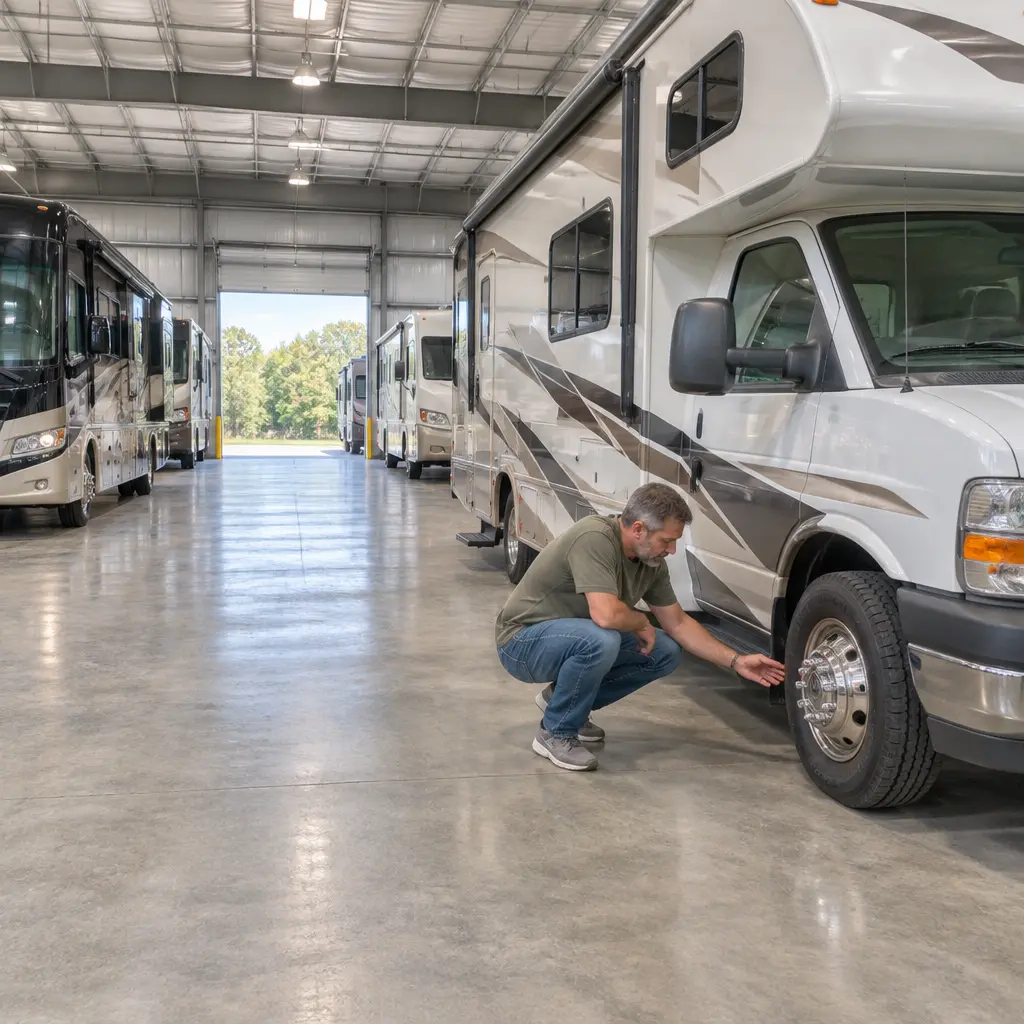
Indoor RV storage means keeping a recreational vehicle inside an enclosed building for some or all of the year, rather than leaving it outdoors. In the first year, owners can undermine the benefits of indoor storage by overlooking moisture, batteries, tires, fire safety, or the storage facility’s rules. The National Fire Protection Association (NFPA) says RVs combine fuel, electrical systems, appliances, and living spaces—features that make careful preparation important—while the Recreation Vehicle Industry Association (RVIA) emphasizes following manufacturer guidance for maintenance and storage. This guide covers the 10 most common first-year mistakes, from choosing a storage space to preparing the RV for its next trip.
Indoor RV storage mistakes and first-year ownership
Indoor storage can reduce exposure to sun, rain, hail, and debris, but it does not automatically preserve an RV. A building may still have temperature swings, leaks, pests, limited ventilation, or restrictions on charging batteries and working on vehicles. The right storage plan depends on the RV’s owner manual, the building’s conditions, local weather, and the length of time the vehicle will sit.
There is no single authoritative national statistic that quantifies how often first-year indoor RV owners make each of these mistakes. The practical risks are nevertheless well established: the U.S. Fire Administration identifies heating and electrical equipment among leading causes of residential fires, and RV manufacturers publish specific procedures for water systems, batteries, tires, and appliances. Treat these points as a risk-based checklist, not a substitute for the storage facility’s rules or the RV’s manual.
1. Assuming “indoors” means climate-controlled
Indoor describes a roof and walls; climate-controlled describes active management of temperature and sometimes humidity. A standard warehouse or enclosed storage bay may protect an RV from direct precipitation while still allowing damp air, condensation, or extreme seasonal temperatures.
Ask the operator what temperature and humidity ranges are maintained, whether those conditions are monitored, and what happens during a power outage. Inspect the space for roof leaks, standing water, musty odors, and signs of condensation. If the building is not humidity-controlled, use moisture-management products suitable for the RV and check them periodically. Do not seal the vehicle so tightly that dampness is trapped inside.
2. Skipping a complete cleaning and inspection
Putting away an RV dirty or unrepaired can make small problems harder to spot later. Food residue attracts pests, road salt and grime can damage finishes, and an unnoticed roof or plumbing leak may continue while the vehicle is stored.
Before storage, wash and dry the exterior, clean the refrigerator and cabinets, remove perishables, and inspect the roof, seals, windows, tires, undercarriage, and visible plumbing. Photograph existing damage and note maintenance items for the next trip. RVIA advises owners to follow the manufacturer’s maintenance schedule; cleaning is a useful opportunity to identify work that should be handled before storage rather than postponed until departure day.
3. Leaving water in the plumbing—or winterizing without checking the climate
Winterizing means protecting the RV’s water system from freezing, typically by draining it and following the manufacturer’s specified procedure. Water left in pipes, pumps, filters, toilets, or appliances can freeze and expand, causing leaks or damaged components. Conversely, applying antifreeze or bypassing appliances incorrectly can create additional work or damage.
Decide whether to winterize based on the building’s actual temperature conditions, the RV manufacturer’s instructions, and the length of storage—not simply on the word “indoor.” Ask whether the facility is heated and whether it guarantees a minimum temperature. If freezing is possible, follow the RV manual’s process for the fresh-water system, water heater, filters, and low-point drains; use only products and methods specified for the vehicle.
4. Ignoring humidity, ventilation, and mold prevention
Condensation forms when moist air meets a cooler surface. In a stored RV, moisture from damp fabrics, wet bathrooms, or outside air can contribute to odors and mold, even inside a covered building.
Dry the interior before closing it up, leave the refrigerator clean and dry with its doors secured as the manufacturer directs, and remove wet towels, rugs, and bedding. Use desiccants or a dehumidifier only when permitted and appropriate for the space; check containers so they do not overflow. If the facility allows it, periodic inspection and carefully managed ventilation can help, but do not leave windows or vents open where rain, pests, or security risks are possible. The U.S. Environmental Protection Agency’s mold guidance stresses moisture control as the key to preventing mold growth.
5. Neglecting batteries—or charging them against facility rules
Batteries self-discharge during storage, and the right maintenance method varies by battery chemistry and RV design. A lead-acid battery may need periodic charging and, where applicable, electrolyte checks; lithium batteries have different charging and temperature requirements. Leaving loads connected can drain either type.
Check the battery manufacturer’s storage guidance and the facility’s rules before disconnecting, removing, or charging batteries. Turn off parasitic loads as directed, keep battery terminals clean, and use only an approved charger or maintenance device. Do not assume shore power is available or permitted. The RV owner’s manual should govern the correct procedure, especially for lithium batteries and integrated battery-management systems.
6. Forgetting tire pressure, load, and periodic movement
Tires lose pressure over time, and long periods parked in one position can stress the same contact areas. Underinflation, overloading, or using an unsuitable tire pressure can create safety problems once the RV is back on the road.
Before storage, inflate tires to the pressure specified for the actual load and the tire or RV manufacturer’s guidance; do not use the maximum sidewall pressure as a universal target. Keep tires out of direct sunlight where possible, avoid overloading the vehicle, and inspect for cracking or damage before travel. Ask the facility whether the RV can be moved safely and whether movement is allowed. Do not start or move a vehicle simply to “exercise” it without a reason and a safe, manufacturer-consistent plan.
7. Leaving food, trash, or pest entry points behind
Rodents and insects can enter through surprisingly small openings, while crumbs, food packaging, and scented supplies make an RV more attractive. Indoor storage reduces some exposure but does not make a vehicle pest-proof.
Remove all food, trash, and pet supplies; clean cupboards and drawers; and inspect seals, vents, and utility openings for gaps. Use pest deterrents only if they are safe for the RV, permitted by the facility, and used according to their labels. Avoid leaving poison or loose traps where they could harm pets, children, or wildlife. Check the vehicle periodically for droppings, nesting material, chewed wiring, and new openings.
8. Storing propane or fuel without checking the rules
Propane and gasoline are combustible fuels, so their storage requires more than simply parking inside. Facilities can impose stricter requirements than local codes, and ventilation, appliance shutoff, and fuel-system handling depend on the RV and site.
Ask the facility in writing whether propane cylinders may remain on board, whether valves must be closed, and whether fuel tanks must be full, low, or treated in a particular way. Follow the vehicle and fuel-system manufacturer’s instructions and applicable fire and safety rules. Never operate heaters, generators, or other combustion appliances inside a storage building unless the facility explicitly permits it and the equipment is designed for that use. The NFPA’s fire-safety guidance reinforces the importance of keeping ignition sources and combustible materials under control.
9. Overlooking insurance, access, and emergency planning
An indoor unit does not guarantee that damage, theft, fire, flooding, or a building failure will be covered. Insurance policies and storage contracts may have exclusions, limits, or requirements for security and maintenance.
Review the storage agreement and ask how access, security, fire protection, water intrusion, and emergency notifications are handled. Confirm with your insurer that the RV remains covered while stored and understand the deductible and exclusions. Keep photographs, the vehicle identification number, policy details, and a current inventory of valuable equipment in a separate, secure location. Update the facility with reliable contact information.
10. Failing to make a return-to-service checklist
An RV that has been stored still needs a careful inspection before driving or using its systems. Batteries may be low, tires may need attention, plumbing may remain winterized, and insects or leaks may have appeared during storage.
Before departure, inspect tires and lights, check battery condition, look for fluid leaks and pest activity, and verify that any winterization steps are reversed correctly. Test the water system, appliances, alarms, brakes, and safety equipment according to the manufacturer’s instructions. Allow enough time for repairs rather than discovering a problem at the campsite. The National Highway Traffic Safety Administration recommends vehicle owners address recalls and safety defects; check whether any recall applies to the RV or its chassis before a trip.
A practical first-year indoor RV storage routine
A simple routine can prevent many avoidable problems. Use the RV manual as the technical authority, the storage contract as the site-specific authority, and your insurer for coverage questions.
- Before signing, verify temperature and humidity conditions, permitted maintenance, battery charging rules, fuel and propane policies, access hours, and emergency procedures.
- Before parking, clean and dry the RV, remove food and waste, inspect for leaks and damage, and document its condition.
- Prepare water systems, batteries, tires, and fuel according to manufacturer instructions and the building’s actual conditions.
- Schedule periodic checks for moisture, pests, battery condition, tire pressure, leaks, and facility changes.
- Before travel, reverse storage preparations carefully and test safety-critical systems.
A checklist graphic could show the timeline as “facility selection → storage preparation → periodic inspection → return to service,” with separate callouts for moisture, water systems, batteries, tires, pests, and safety. This visual makes clear that indoor storage is a process, not a one-time parking decision.
Conclusion: protect the RV by managing the details
The biggest first-year indoor RV storage mistakes are assuming the building controls climate, skipping cleaning and inspection, mishandling water systems or batteries, neglecting moisture and tires, inviting pests, overlooking fuel rules, and failing to plan for insurance and the next trip. Indoor storage can reduce exposure to weather, but it does not replace maintenance or safety checks. Read the RV manual, confirm facility policies in writing, and create a routine for inspections before and after storage. Owners looking for next steps should review the manufacturer’s storage instructions, RVIA maintenance resources, and relevant NFPA and EPA safety guidance.
Sources: Recreation Vehicle Industry Association, RV Owner Resources, https://www.rvia.org/rv-owners; National Fire Protection Association, RV Safety, https://www.nfpa.org/education-and-research/home-fire-safety/rv-safety; U.S. Environmental Protection Agency, A Brief Guide to Mold, Moisture and Your Home, https://www.epa.gov/mold/brief-guide-mold-moisture-and-your-home; U.S. Fire Administration, Fire Safety, https://www.usfa.fema.gov/prevention/home-fires/; National Highway Traffic Safety Administration, Recalls, https://www.nhtsa.gov/recalls.
Related Posts

How Indoor Heated Storage Beats Traditional Cold-Weather RV Strategies
Indoor Heated Storage and Its Advantages for Cold-Weather RV Preservation Indoor heated storage refers to [...]

Utility Access and Climate Control Features in Premium Heated Storage
Utility Access in Premium Heated Storage Premium heated storage units refer to high-end storage solutions [...]

What to Consider Before Deciding Between Indoor or Outdoor RV Parking
Indoor vs. Outdoor RV Parking: Key Considerations for Storage Decisions Recreational Vehicle (RV) owners face [...]