
Living full-time in an RV park means using a campground or RV community as your regular home rather than stopping for occasional vacations. It can offer a lower-cost, flexible way to live, but the experience depends on monthly site fees, utility arrangements, park rules, weather, and how much privacy and stability you need. The trade-offs matter to a growing number of people: the RV Industry Association reported that an estimated 11.2 million U.S. households owned an RV in 2021, though ownership does not mean those households live in one full-time. Understanding the everyday realities—housing costs, utilities, community, maintenance, and legal limits—helps prospective residents judge whether park living fits their budget and lifestyle.
Full-Time RV Park Living and Its Housing Trade-Offs
Full-time RV park living is a residential arrangement in which a person or household occupies an RV at a park for an extended period, often under a monthly or seasonal site agreement. The National Association of RV Parks and Campgrounds describes parks as places offering sites and related amenities to RV travelers; however, a park’s willingness to accept long-term guests does not automatically make it a legally recognized permanent residence. Full-time residents should confirm whether local rules, the park’s lease, and their intended use permit year-round occupancy.
The arrangement has several forms: a long-term stay at a privately operated campground, a seasonal placement, a space in an age-restricted RV community, or a rotating lifestyle that combines extended stays at multiple parks. These are not interchangeable. Some parks are designed for transient visitors, while others provide monthly rates, mail services, laundry, and longer-term infrastructure. As a bridge between housing costs and daily routines, the park’s specific operating model matters as much as the RV itself.
Monthly costs are broader than the site fee
A site fee is the charge for parking and connecting an RV at a particular space. It may include water, sewer, Wi-Fi, or electricity, or bill some services separately. Residents also need to budget for the RV payment or depreciation, insurance, fuel, repairs, propane, laundry, phone service, storage, and occasional campground moves. The U.S. Bureau of Labor Statistics’ Consumer Expenditure Survey tracks housing and transportation as major household spending categories; RV living changes how those expenses appear, but it does not eliminate them.
A useful comparison is the all-in monthly cost, not the advertised nightly or monthly rate. Ask whether electricity is metered, whether the park charges extra for additional people or pets, and whether rates change by season. A low site fee may be offset by high electric bills in extreme heat or cold, while a higher rate may include reliable utilities and amenities. Rates vary substantially by region and season, so obtain a written quote for the exact dates and length of stay.
The RV’s size and layout shape everyday comfort
An RV is a compact dwelling built for mobility, and its usable space is shaped by floor plan, storage, insulation, and the number of occupants. Living in it full-time can make ordinary tasks—cooking, working, exercising, or storing seasonal clothing—require more planning than in a conventional home. Slide-outs can expand living space when parked, but they require room and may add mechanical components that need maintenance.
Before committing, spend time in the same model or a similar floor plan. Check whether the bathroom, bed, kitchen, and workspace remain practical when the RV is packed for real life rather than a weekend trip. The Federal Highway Administration’s vehicle-size and road-use guidance is also relevant when a household plans to move frequently: a larger rig can limit access to some roads, bridges, fuel stations, and park sites.
Daily Life Depends on Utilities, Weather, and Maintenance
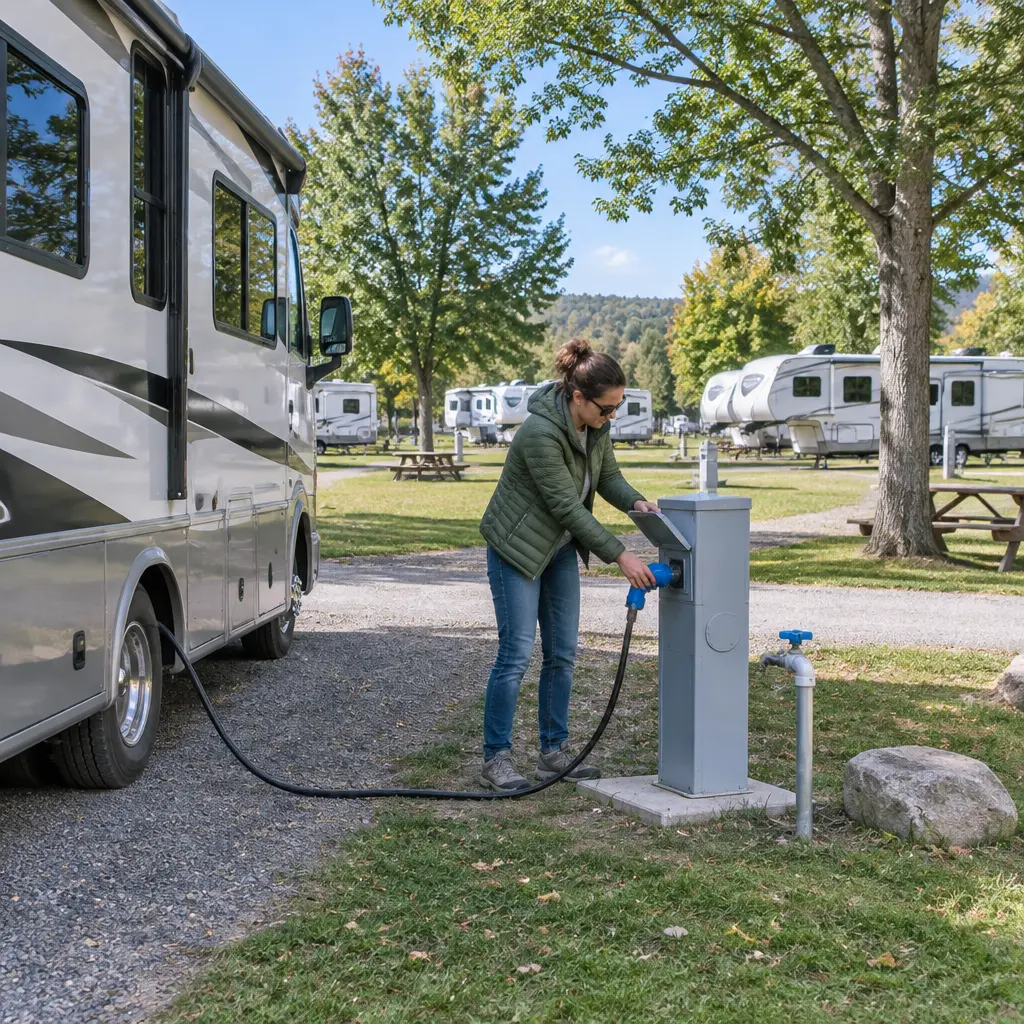
The practical quality of full-time RV living depends on the systems that make a small vehicle function like a home. These include electrical hookups, potable water, sewer connections, heating and cooling, and reliable internet. A park may offer full hookups, partial hookups, or shared facilities; “full hookup” generally means that a site provides electric, water, and sewer connections, but residents should verify the exact service and capacity before arrival.
Water, sewer, and power require active management
RV utilities are the services that support daily household use in a compact unit. Residents may need to monitor tank levels, use appropriate hoses and electrical equipment, and follow park instructions for wastewater disposal. A full hookup simplifies these tasks but does not remove the need to inspect connections or conserve water. The U.S. Environmental Protection Agency’s WaterSense program notes that household leaks can waste significant amounts of water; in an RV, a small leak can also cause costly damage in a confined space.
Electrical capacity is another practical constraint. Air conditioners, heaters, cooking appliances, and chargers can place heavy loads on a system. Confirm the site’s amperage and whether the RV’s equipment is compatible; do not assume that every outlet can safely support every appliance. For drinking water, use clean, food-grade hoses and follow local advisories. If a park supplies water from a private system, ask how residents can review water-quality information and report service problems.
Weather exposes the limits of mobile housing
Weather resilience is the ability of an RV and its occupants to remain safe and functional through heat, cold, wind, rain, and severe storms. Many recreational vehicles are less insulated than conventional houses, so temperature control can be expensive or uncomfortable. Cold weather can threaten water lines and tanks, while high heat can strain air conditioning and increase electricity use. The National Weather Service advises people to prepare for local hazards and follow official warnings; RV residents should identify shelter options and evacuation routes before severe weather arrives.
Park residents should learn where to go if a storm, wildfire, flood, or evacuation order makes the site unsafe. A towable RV may be movable, but moving it during dangerous conditions is not always possible or advisable. Check whether the park has written emergency procedures, whether the site is in a flood-prone area, and whether insurance covers the relevant risks.
Repairs are part of the housing routine
RV maintenance includes preserving the roof, tires, brakes, batteries, plumbing, appliances, and seals against water intrusion. The Recreational Vehicle Industry Association recommends regular inspection and maintenance because components are exposed to road vibration and weather even when the vehicle is stationary. A roof leak or failed appliance can disrupt daily life quickly, particularly when there is little spare space or no nearby repair provider.
Residents can reduce surprises by keeping a maintenance log, setting aside a repair reserve, and identifying nearby RV service shops before a breakdown. A park’s maintenance staff may handle site utilities but generally should not be assumed to repair residents’ vehicles. This maintenance burden connects directly to another defining feature of park life: the balance between independence and reliance on shared community services.
Community, Privacy, and Park Rules Shape the Experience
An RV park is a shared residential environment, so daily life involves both social contact and rules governing common spaces. Some residents appreciate meeting neighbors and using shared laundry rooms, pools, clubhouses, or organized activities. Others find close spacing, noise, or limited privacy challenging. Amenities and social culture differ widely; a listing that advertises a pool or internet does not guarantee that the facility is open year-round or reliable enough for work.
Community can be welcoming but is not guaranteed
Community in an RV park means the relationships and informal support that develop among residents and staff. Long stays can make it easier to build connections than brief visits, but turnover may still be high, and residents may leave when seasons, work, or rates change. The National Association of RV Parks and Campgrounds’ industry materials describe parks as recreation and lodging businesses, not necessarily as social-service communities, so residents should not assume that a park will provide ongoing personal support.
A real-world example is a winter resident who returns to the same warm-weather park each year. Familiar neighbors and routines may create a sense of belonging, while a first-time resident arriving mid-season may encounter an established social circle. Visiting before signing, asking about resident events, and speaking with current long-term guests can provide a more accurate picture than promotional photographs.
Rules affect pets, visitors, noise, and length of stay
Park rules are the contractual and operational requirements residents agree to follow. Common topics include quiet hours, pets, guests, parking, outdoor furniture, fire safety, laundry use, and restrictions on how long someone can remain. Some parks limit consecutive nights or require residents to leave periodically. Read the written policies before paying a deposit, and clarify whether a monthly rate creates a tenancy or only a license to occupy a site under local law.
The legal distinction matters because residential protections vary by state and locality. A park may be subject to zoning, health, fire, and landlord-tenant rules, but the specific rules depend on the property and arrangement. The Consumer Financial Protection Bureau advises consumers to understand the terms of financial and housing agreements; for an extended RV stay, keep copies of the site agreement, rate schedule, utility terms, and written notices.
Mail, work, and healthcare need advance planning
A full-time resident still needs a dependable way to receive important correspondence, maintain an address for official purposes, access healthcare, and work or study. Parks vary in whether they accept mail and packages. A mailing service or trusted permanent address may be necessary, but residency, vehicle registration, taxes, voting, and insurance requirements are governed by state and local rules. The U.S. Postal Service’s address-change and delivery options can help with mail logistics, but they do not determine legal domicile.
Remote workers should test internet service at the actual site, not rely solely on a park-wide claim. Cellular coverage can vary by carrier and terrain, and shared Wi-Fi may become congested at peak times. For healthcare, identify nearby clinics, pharmacies, and emergency departments before moving, and confirm how health insurance handles care across state lines.
Who Benefits Most—and What to Check Before Moving In
Full-time RV park living tends to work best for people who value mobility, can tolerate compact space, and are comfortable managing repairs and logistics. It may be less suitable for households that need consistent privacy, extensive storage, stable school arrangements, or a guaranteed long-term site. The RV Industry Association’s ownership figures show a substantial U.S. RV market, but those numbers describe ownership, not the share of people choosing full-time park residence. Prospective residents should treat personal fit and local conditions as more useful than broad industry totals.
A practical pre-move checklist
A pre-move checklist is a way to test whether the RV, park, and household budget are compatible before making a long commitment. Compare total monthly expenses against current housing costs, inspect the site and hookups, and verify the park’s occupancy terms in writing. A short trial stay through different weather or work conditions can reveal issues that a weekend visit will not.
- Confirm year-round occupancy, permitted length of stay, renewal terms, deposits, and rate increases.
- Ask which utilities are included, how electricity is billed, and what hookup capacity the site provides.
- Inspect the RV’s roof, tires, plumbing, appliances, heating, cooling, and storage for full-time use.
- Check local zoning and residency rules, plus mail, vehicle registration, insurance, and tax requirements.
- Test internet and phone service at the site and map nearby healthcare, grocery, and repair services.
- Review emergency procedures, weather exposure, park rules, pet policies, and cancellation terms.
- Maintain a repair fund and a backup plan for temporary lodging if the RV needs major service.
Conclusion: Full-Time RV Park Living Is a Lifestyle, Not Just a Cheaper Address
Living full-time in an RV park can provide mobility, amenities, and a close-knit setting, but it is not simply a lower-cost version of conventional housing. The real experience is shaped by the full monthly budget, the RV’s space and condition, dependable utilities, weather risks, park rules, and access to work, mail, and healthcare. Industry statistics confirm that RV ownership is widespread, yet they do not establish that full-time park living is inexpensive or suitable for every household.
Before moving, compare all-in costs, verify legal and park-specific terms, and test the RV and location under ordinary living conditions. Prospective residents can also consult local housing and consumer-protection agencies, the National Association of RV Parks and Campgrounds, and RV maintenance guidance from the Recreational Vehicle Industry Association. A careful trial and written plan can turn an appealing idea into a more informed decision.
Sources: RV Industry Association, RV Ownership Statistics, https://www.rvia.org/rv-ownership-statistics; National Association of RV Parks and Campgrounds, About the Association, https://arvc.org/about-arvc/; U.S. Bureau of Labor Statistics, Consumer Expenditure Surveys, https://www.bls.gov/cex/; Federal Highway Administration, Vehicle Size and Weight, https://www.fhwa.dot.gov/; U.S. Environmental Protection Agency, WaterSense, https://www.epa.gov/watersense; National Weather Service, Weather Safety, https://www.weather.gov/safety/; RV Industry Association, RV Technical and Safety Information, https://www.rvia.org/; Consumer Financial Protection Bureau, Renting a Home, https://www.consumerfinance.gov/consumer-tools/renting-a-home/; U.S. Postal Service, Change of Address, https://www.usps.com/manage/forward.htm.
Related Posts
The Best Websites for Finding Monthly RV Parks
Monthly RV parks are campgrounds and RV resorts that rent sites by the month, often [...]
Walking Through Dozens of Parks Shows Where Safety Usually Breaks Down
Walking dozens of parks reveals that safety usually breaks down at the points where upkeep, [...]

If You Want Hassle-Free RV Life These Full Hookup Features Matter Most
Full Hookup Amenities and Hassle-Free RV Living Full hookup RV sites are designated camping spots [...]