
An RV is both a vehicle and a temporary home, carrying valuables, documents, equipment, and personal information wherever its owner travels. Yet security often receives attention only after a theft or break-in. That risk is not merely theoretical: the National Insurance Crime Bureau reported 1,008,756 vehicle thefts in the United States in 2022, although that national figure includes all vehicle types and is not an RV-specific rate. A practical RV security plan therefore combines theft prevention, protection for valuables and data, safe parking habits, and preparation for incidents—without assuming that any single lock or alarm can guarantee safety.
RV security protects the vehicle, belongings, and people
RV security means the measures used to reduce the chance of unauthorized access, theft, damage, or exposure of personal information involving a recreational vehicle and its occupants. The National Institute of Standards and Technology describes security in broader information-system terms as protecting systems and information against unauthorized access, use, disclosure, disruption, modification, or destruction. Applied to RV travel, that idea covers physical entry as well as the phones, accounts, and devices used on the road.
RV security has several related categories: vehicle theft prevention, entry-point protection, protection of cargo and personal property, campground and overnight safety, and digital privacy. These categories overlap. A stolen key or exposed travel itinerary can undermine physical safeguards, while a damaged door can put both people and belongings at risk. The FBI’s National Incident-Based Reporting System tracks crime categories such as burglary and theft, but its national crime data do not provide a reliable RV-specific theft rate. Owners should therefore treat general vehicle-crime figures as context, not as a prediction of their individual risk.
RV security includes more than locks
A lock is a physical barrier, but security is a layered process: deter, detect, delay, and respond. A wheel lock may make a vehicle harder to move; an alarm may draw attention; a camera may help document an event; and an inventory with serial numbers can support a police report or insurance claim. No device is foolproof, and equipment works best alongside sensible routines such as securing doors, closing windows, and avoiding public posts that reveal when an RV will be unattended.
Risk varies by RV type and use
Motorhomes, travel trailers, fifth wheels, and camper vans present different security challenges. A motorhome may be driven away, while a trailer may be unhitched or its contents targeted. RVs used as full-time homes can hold more possessions and documents than occasional-use campers. The National Highway Traffic Safety Administration advises vehicle owners to remove keys, lock doors, and park in well-lit areas—basic precautions that also apply when an RV is left at a campground, storage facility, or roadside stop.
RV theft prevention starts with layered physical protection
RV theft prevention combines measures that make unauthorized movement or entry more difficult and easier to notice. The NICB’s Hot Spots report recorded 1,008,756 motor vehicle thefts nationwide in 2022, a 7 percent increase from 2021. Those totals are not limited to recreational vehicles, but they illustrate why owners should not rely on a vehicle’s size, storage location, or appearance as a deterrent.
Entry-point protection secures doors, windows, and compartments
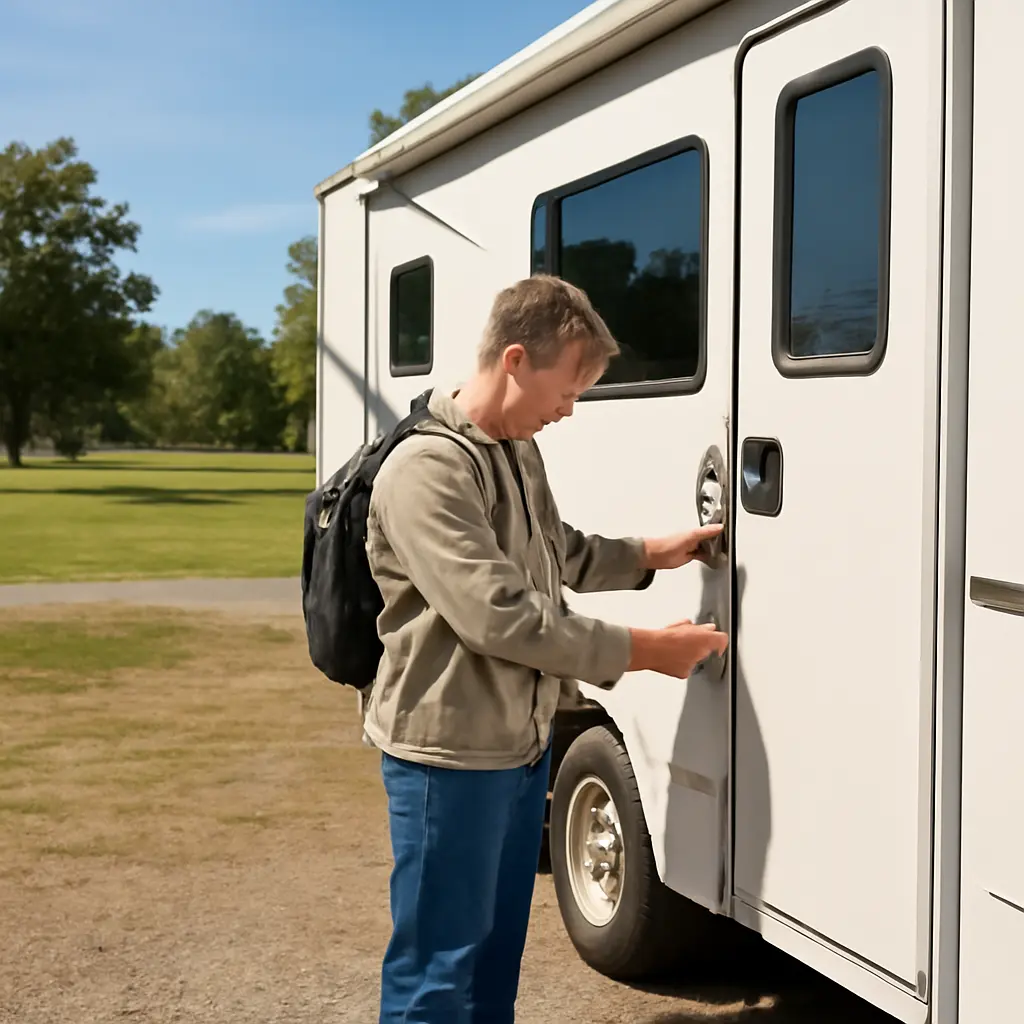
Entry-point protection means strengthening the places an intruder is most likely to test, including entrance doors, cab doors, windows, storage bays, and exterior utility compartments. Owners can use manufacturer-compatible deadbolts or additional door hardware, lock storage compartments, and check that latches are aligned and functioning. Before adding hardware, consult the RV manufacturer or a qualified installer: modifications can affect emergency egress, warranties, or door operation. Keep keys controlled, and avoid hiding a spare in an obvious exterior location.
Trailer and wheel security reduces unauthorized movement
Trailer security focuses on preventing a trailer from being hitched, rolled, or separated without permission. Depending on the vehicle and parking situation, owners may use a coupler lock, wheel chock lock, or hitch lock, and park with the hitch positioned to limit easy access. These devices are deterrents rather than guarantees. Owners should select equipment rated for their trailer and hitch, follow installation instructions, and avoid blocking emergency access or creating a tripping hazard.
Alarms, cameras, and trackers improve detection and recovery
Electronic security tools help detect activity, record evidence, or assist with locating a vehicle. A motion sensor or alarm can alert occupants; a camera can capture a visible approach; and a GPS tracker may provide location information if an RV is moved. Coverage, power, cellular service, subscription requirements, and privacy rules all affect performance. A camera is not a substitute for a lock, and a tracker is most useful when owners know how to access its account and can promptly share location information with law enforcement.
RV valuables and identity need separate protection
Protecting an RV means safeguarding what is inside as well as the vehicle itself. Cash, tools, electronics, prescriptions, travel documents, and identity records can be lost in a single incident. The Federal Trade Commission recommends securing personal information and monitoring financial accounts because identity theft can involve misuse of personal data, not only physical theft of a wallet. A thoughtful plan limits what is left visible, records what is carried, and reduces the amount of sensitive information stored in the RV.
Inventory and documentation support recovery and claims
A home inventory is a dated record of possessions, including descriptions, photographs, receipts when available, and serial numbers for high-value electronics or equipment. The Insurance Information Institute recommends keeping an inventory to help document property after a loss. RV owners can store a copy securely online and keep a separate accessible copy outside the vehicle. Photograph the RV’s identification numbers and major upgrades, but do not post these details publicly.
Digital security protects accounts and travel information
Digital security covers the phones, tablets, Wi-Fi routers, and online accounts that support RV travel. Use unique passwords and multifactor authentication for email, financial, insurance, and tracking accounts; install software updates; and avoid conducting sensitive transactions over unsecured public Wi-Fi. The Federal Trade Commission advises consumers to use strong passwords and multifactor authentication where available. Owners should also limit real-time social posts that disclose their location or announce that a home or RV will be unattended.
Campground and storage habits shape everyday RV safety
Security depends on context as well as equipment. A well-maintained alarm may be less helpful if an RV is routinely left unlocked, while an attentive owner can reduce exposure by choosing a suitable site and following consistent departure and arrival routines. The National Park Service advises visitors to protect valuables and secure vehicles at recreation sites; the same habits are relevant at campgrounds, trailheads, and overnight stops.
Parking choices reduce opportunity
Choose a site that is visible, appropriately lit, and consistent with campground rules. When stopping briefly, keep the RV in view when practical and avoid leaving valuables visible through windows. At storage facilities, ask about access controls, lighting, surveillance, visitor procedures, and how staff respond to alarms. No location can eliminate risk, so owners should still lock the vehicle and secure loose equipment.
Departure and arrival checklists close routine gaps
A checklist turns security into a repeatable habit. Before leaving, lock doors and compartments, close windows, secure exterior equipment, and confirm that keys and documents are accounted for. On arrival, inspect the site and the vehicle for signs of tampering before unpacking. At a stop, keep essential items such as identification, medication, and a phone accessible rather than placing everything in a hard-to-reach storage bay.
Incident preparation makes response faster
Preparation means knowing what to do if a theft, break-in, or suspicious approach occurs. Keep insurer and roadside-assistance details available outside the RV, record the local emergency number when traveling internationally, and know how to report a crime in the area. If a theft occurs, contact law enforcement promptly, provide the vehicle identification number and tracker information if available, and notify the insurer. Do not confront a suspected intruder; prioritize people’s safety and follow local emergency guidance.
A practical RV security plan is layered and routine
A useful plan matches protections to the RV, the owner’s travel patterns, and the value of what is carried. Start with working door and compartment locks, then add trailer or wheel safeguards where relevant. Consider alarms, cameras, or tracking based on coverage and power needs. Maintain an inventory, protect online accounts, choose parking carefully, and practice a brief security checklist at every stop. Review insurance coverage and keep policy details and vehicle records accessible if the RV is unavailable.
RV security is easiest to overlook because many trips pass without incident. But the scale of vehicle theft in national data, combined with the concentration of belongings and travel documents in a mobile home, makes prevention worth addressing before something goes missing. Secure the vehicle, reduce visible temptation, protect personal information, and prepare a calm response plan. Owners can begin today by checking every entry point, documenting valuables, and identifying one security improvement suited to their RV.
Sources: National Insurance Crime Bureau, Hot Spots: Vehicle Theft Trends and Insights, 2022, https://www.nicb.org/news/news-releases/hot-spots-vehicle-theft-trends-and-insights; National Highway Traffic Safety Administration, Vehicle Theft Prevention, https://www.nhtsa.gov/vehicle-safety/vehicle-theft-prevention; Federal Bureau of Investigation, National Incident-Based Reporting System, https://www.fbi.gov/how-we-can-help-you/more-fbi-services-and-information/ucr/nibrs; National Institute of Standards and Technology, The NIST Cybersecurity Framework (CSF) 2.0, https://www.nist.gov/cyberframework; Federal Trade Commission, Identity Theft, https://consumer.ftc.gov/features/identity-theft; Federal Trade Commission, Use Strong Passwords and Multifactor Authentication, https://consumer.ftc.gov/articles/how-protect-your-personal-information; Insurance Information Institute, How to Create a Home Inventory, https://www.iii.org/article/how-create-home-inventory; National Park Service, Protect Your Valuables, https://www.nps.gov/subjects/healthandsafety/protect-your-valuables.htm.
Related Posts

Which Amenities Matter Most When Evaluating Indoor RV Options
Amenities Importance in Indoor RV Options When evaluating indoor recreational vehicle (RV) options, amenities refer [...]

If You Want to Live in Your RV All Year These Practical Solutions Work
Practical Solutions for Year-Round RV Living Living in a recreational vehicle (RV) throughout the year [...]

How Skipping Regular Maintenance Turns Year-Round RV Living Into a Headache
The Relationship Between Regular Maintenance and Year-Round RV Living Recreational Vehicles (RVs) offer a mobile [...]