
Indoor ventilation is the intentional exchange or treatment of indoor air to manage pollutants, moisture, odors, and carbon dioxide. It often goes unnoticed when choosing a home, but weak ventilation can contribute to stale air, condensation, lingering cooking fumes, and exposure to indoor pollutants. The U.S. Environmental Protection Agency (EPA) notes that people spend about 90% of their time indoors, making indoor air quality consequential; meanwhile, the American Society of Heating, Refrigerating and Air-Conditioning Engineers (ASHRAE) treats ventilation as part of a broader strategy that also includes filtration and source control. Here’s what to check before buying: how ventilation works, which systems are common, what evidence to look for, and how to assess costs and maintenance.
Ventilation performance defines the home’s indoor-air baseline
Ventilation is the controlled supply of outdoor air to a building and removal or dilution of indoor air. ASHRAE Standard 62.2 addresses ventilation and acceptable indoor air quality in residential buildings, while emphasizing that ventilation is only one element of indoor-air management. The required system and airflow depend on the building, its climate, occupancy, and applicable local codes; there is no single airflow figure that can be assumed suitable for every home.
A useful distinction is between ventilation, air filtration, and air cleaning. Ventilation replaces or dilutes indoor air with outdoor air; filtration removes some particles from air passing through a filter; and air cleaners may target specific pollutants. Opening a window can ventilate a room when outdoor conditions allow, but it is not a dependable year-round mechanical system. A recirculating range hood may capture grease and some particles, yet it does not exhaust air outdoors.
Outdoor-air supply and exhaust
Supply ventilation brings outdoor air inside, exhaust ventilation removes indoor air, and balanced ventilation does both. In a balanced system, the two airflows are designed to be broadly comparable, though actual performance depends on installation and commissioning. Exhaust fans in bathrooms and kitchens are common examples of localized ventilation; they are most useful when they discharge outdoors rather than into an attic or another enclosed space.
Ventilation is not a substitute for source control
Source control means reducing pollutants where they originate—for example, using an externally vented range hood while cooking, storing chemicals safely, and fixing moisture leaks. EPA guidance identifies source control, improved ventilation, and air cleaning as complementary approaches. Ventilation can dilute some contaminants, but it cannot reliably compensate for every source, and outdoor air itself may contain smoke, traffic pollution, pollen, or other pollutants.
Home ventilation systems differ in control, comfort, and upkeep
Residential ventilation systems range from intermittent exhaust fans to continuous whole-house systems. The right choice depends on the home’s layout and airtightness, local climate, household needs, and whether equipment is installed and maintained correctly. A product label alone does not establish how much fresh air reaches occupied rooms or whether the system works as intended.
Local exhaust: bathrooms and cooking areas
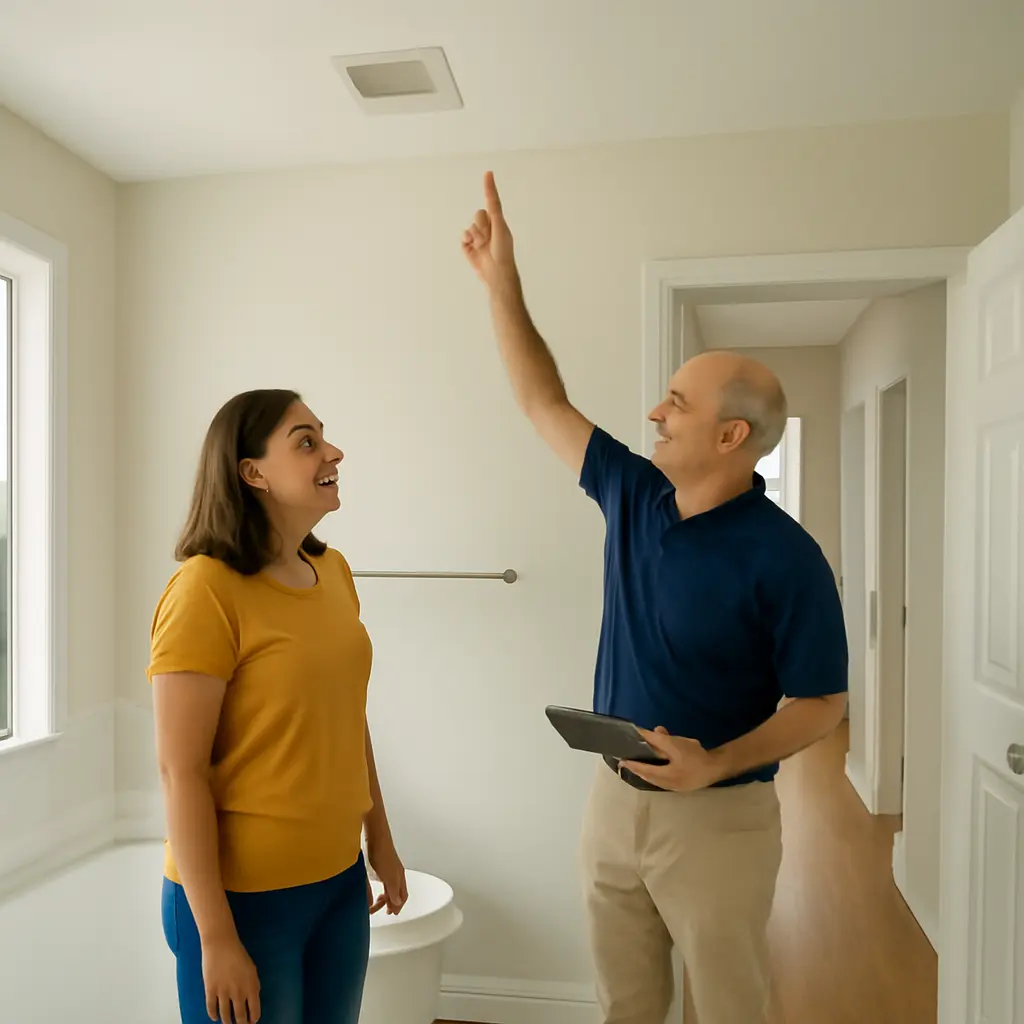
Local exhaust removes moisture or cooking emissions near their source. Bathroom fans should vent to the exterior and run long enough to clear moisture; kitchen range hoods are more effective when they capture emissions and exhaust outdoors. Check whether the fan is quiet enough that occupants will use it, whether its duct is correctly routed, and whether the outdoor termination is unobstructed.
Whole-house exhaust, supply, and balanced systems
A whole-house exhaust system uses fans to expel air, with replacement air entering through planned inlets or leaks. A supply system mechanically introduces outdoor air, while balanced systems provide both supply and exhaust. In cold or hot climates, bringing in untreated outdoor air can affect comfort and energy use, so system design and controls matter. Ask whether the system has been airflow-tested and how it responds to the home’s heating and cooling equipment.
Heat- and energy-recovery ventilation
A heat-recovery ventilator (HRV) transfers heat between outgoing and incoming air; an energy-recovery ventilator (ERV) transfers heat and some moisture. These systems can reduce the heating or cooling penalty associated with ventilation, but performance varies with climate, equipment, duct design, and maintenance. Filters and heat- or energy-exchange cores need inspection and cleaning according to manufacturer instructions. Ask for model information, service records, and evidence that the system is balanced and operating.
Ventilation problems show up as moisture, odors, and poor airflow
Poor ventilation does not always announce itself with a single obvious symptom. Persistent condensation, musty odors, slow-drying bathrooms, or cooking smells that linger can point to inadequate exhaust, moisture problems, or both. These signs are clues—not proof of a specific ventilation defect—so buyers should investigate rather than assume a fan or open window solves the issue.
Moisture and mold risk
Moisture from showers, cooking, occupants, and leaks must be managed through source control, appropriate exhaust, and building-envelope repairs. EPA guidance recommends drying wet materials promptly and fixing water problems because mold can grow where moisture persists. Visible mold or a persistent musty smell should prompt investigation of the moisture source; simply increasing ventilation may not correct a roof, plumbing, or drainage leak.
Combustion appliances and pressure imbalance
Exhaust fans can change indoor pressure. In homes with fuel-burning appliances, poor design or excessive depressurization may contribute to backdrafting, allowing combustion gases to spill indoors. The U.S. Consumer Product Safety Commission warns that carbon monoxide is an odorless, colorless gas that can cause illness or death. Buyers should confirm that fuel-burning equipment is properly installed and vented, maintain working carbon-monoxide alarms, and have concerns evaluated by qualified professionals.
Tight homes need deliberate ventilation
Air sealing reduces uncontrolled drafts and can improve comfort and energy performance, but it also makes planned ventilation more important. A home that feels airtight is not necessarily well ventilated, and a drafty home is not necessarily receiving clean, consistent outdoor air. The Department of Energy’s building guidance treats air sealing and ventilation as connected parts of home performance: buyers should assess them together rather than treating drafts as a ventilation plan.
A ventilation inspection turns claims into verifiable evidence
A practical pre-purchase assessment should combine observation, documentation, and testing. The goal is to determine what equipment exists, where air goes, whether it operates, and what upkeep or correction may be needed—not to infer performance from a switch, thermostat, or equipment nameplate alone.
Questions to ask the seller or inspector
- Which rooms have exhaust or supply ventilation, and where do the ducts terminate?
- Does the range hood exhaust outdoors, or does it recirculate air?
- Is there a whole-house ventilation system, and are operating instructions and service records available?
- Have airflow rates been measured or the system balanced after installation?
- Are there recurring condensation, dampness, odor, or mold complaints?
- When were filters, fans, ducts, and heat- or energy-recovery components last inspected?
Simple checks and professional testing
Listen for unusual fan noise, look for blocked grilles, and verify that fans discharge outdoors where accessible. A tissue held near an exhaust grille can indicate airflow, but it cannot establish an adequate measured rate. For a whole-house system, a qualified HVAC professional can inspect installation and measure airflow; for combustion-safety concerns, use a specialist familiar with the specific appliances and local requirements. Carbon-dioxide readings can offer context about occupancy and ventilation, but a single reading is not a complete indoor-air-quality assessment or a substitute for identifying pollutant sources.
Consider operating costs and maintenance
Ventilation has ongoing costs: electricity for fans, possible heating or cooling of incoming air, filter replacement, and periodic servicing. Recovery systems can temper some energy impacts, but their actual savings depend on climate, system efficiency, controls, and proper use. Request manufacturer documentation and compare maintenance requirements before treating a system as a selling point.
Conclusion: evaluate ventilation before the purchase, not after
Ventilation sets an important indoor-air baseline, but system type, source control, moisture management, combustion safety, and maintenance all affect real-world performance. Local exhaust, whole-house supply or exhaust, and HRV or ERV systems each have different strengths and limitations. The EPA’s estimate that people spend about 90% of their time indoors underscores why these details deserve attention during a home purchase.
Before closing, ask for ventilation equipment records, confirm exhaust routes, investigate signs of moisture, and request professional testing when performance or safety is uncertain. A little due diligence can turn an overlooked feature into a clearer picture of the home’s comfort, upkeep, and indoor-air risks.
Sources: U.S. Environmental Protection Agency, “The Inside Story: A Guide to Indoor Air Quality,” https://www.epa.gov/indoor-air-quality-iaq/inside-story-guide-indoor-air-quality; ASHRAE, “ANSI/ASHRAE Standard 62.2: Ventilation and Acceptable Indoor Air Quality in Residential Buildings,” https://www.ashrae.org/technical-resources/bookstore/standards-62-1-62-2; U.S. Environmental Protection Agency, “A Brief Guide to Mold, Moisture and Your Home,” https://www.epa.gov/mold/brief-guide-mold-moisture-and-your-home; U.S. Consumer Product Safety Commission, “Carbon Monoxide Questions and Answers,” https://www.cpsc.gov/Safety-Education/Safety-Education-Centers/Carbon-Monoxide-Information-Center/Carbon-Monoxide-Questions-and-Answers; U.S. Department of Energy, “Air Sealing Your Home,” https://www.energy.gov/energysaver/air-sealing-your-home.