
Professional RV parks are purpose-built facilities for recreational vehicles, typically offering planned sites, utility connections, sanitary services, and guest amenities. Compared with many basic campgrounds, they tend to provide more reliable infrastructure, broader services, and a more consistent stay—but features vary, and the label “RV park” does not guarantee a particular standard. That distinction matters as the U.S. National Park Service reports more than 325 million recreation visits to national parks in 2023, while RV travel relies on a much wider mix of private parks, public campgrounds, and other places to stay. Understanding the differences in site design, utilities, services, and rules helps travelers choose the right fit for their rig, budget, and travel style.
Professional RV Parks Offer More Developed Sites and Utilities
An RV park’s defining practical feature is often a site designed around vehicle access and hookups. The National Association of RV Parks and Campgrounds (ARVC) describes the sector as a range of privately operated outdoor hospitality properties; amenities and service levels differ from one property to another. A basic campground may focus on a place to pitch a tent or park overnight, while a developed RV park commonly plans for larger vehicles, repeat stays, and on-site utility connections.
Full-hookup sites connect power, water, and sewer
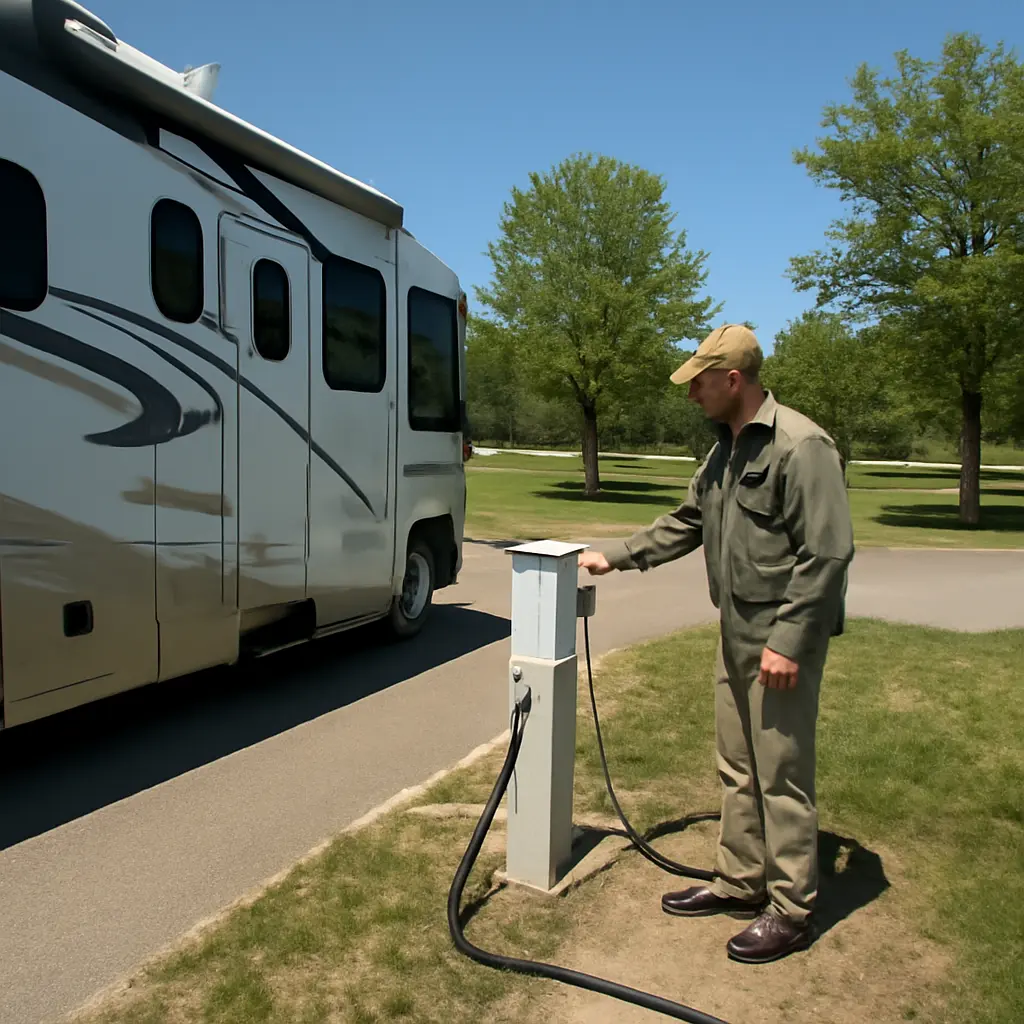
A full-hookup site generally provides electrical service, potable water, and a sewer connection at or near the site. Partial-hookup sites may offer only electricity and water, while primitive campsites often have no individual connections. Electrical capacity matters: RV parks commonly advertise 30-amp or 50-amp service, and travelers should match the available service to their vehicle and equipment rather than assume every site supports high-demand appliances.
The U.S. Environmental Protection Agency’s guidance on private wells and drinking water underscores why travelers should ask how a property supplies and manages its water. Hookups are convenient, but they do not by themselves certify water quality or guarantee that connections will suit every RV. Before booking, confirm amperage, sewer arrangements, connector requirements, and whether the site can accommodate the vehicle’s length and slide-outs.
Purpose-built layouts accommodate larger rigs
Professional parks often provide designated RV pads, marked roads, turning space, and pull-through sites that allow a rig to enter and exit without backing into a space. These layouts can make arrival easier for long motorhomes and vehicles towing trailers. By contrast, a traditional campground may have narrow roads, uneven terrain, or sites intended primarily for tents and smaller vehicles.
“Big-rig friendly” is not a universal engineering standard, so travelers should verify site dimensions, overhead clearance, road conditions, and access to the assigned space. A useful comparison is a reservation map or written site specification, not simply the property’s general description.
Professional RV Parks Add Operational Services and Shared Amenities
Infrastructure is only part of the difference. Many professionally operated parks also provide services that make longer stays and frequent arrivals easier. These may include staffed or online check-in, reservations, restrooms, laundry, waste disposal, and recreation areas. The availability, condition, and cost of each feature should be checked directly with the park.
Sanitation and maintenance facilities support longer stays
Shared restrooms, showers, laundry rooms, dump stations, and refuse collection can reduce the need to rely exclusively on a vehicle’s onboard systems. Some parks offer a dump station for guests without sewer hookups; others provide sewer connections at individual sites. The Centers for Disease Control and Prevention advises travelers to use safe water and maintain hygiene while camping, making clean, accessible sanitation facilities a practical consideration—not merely a luxury.
Recreation and convenience amenities broaden the experience
Pools, playgrounds, dog areas, Wi-Fi, camp stores, picnic shelters, and organized activities are common examples of optional park amenities. Some properties are designed as destination resorts, while others provide only the essentials for an overnight stop. These facilities can be especially valuable to families, remote workers, and guests staying for weeks, but they may also contribute to higher nightly rates or additional fees.
A park’s amenity list should be treated as a starting point, not a quality rating. Ask whether Wi-Fi reaches the site, whether facilities are seasonal, and whether amenities require separate payment. Recent guest reviews can also help establish whether advertised features are operating and well maintained.
Professional RV Parks Differ from Public and Primitive Campgrounds
“Campground” is a broad term covering public lands, private properties, and sites with very different levels of development. A primitive campground may offer little beyond a designated space and basic toilets; a public campground may provide water or electrical hookups but limited services; and a private RV park may combine full hookups with staffed operations and leisure amenities. These are tendencies, not fixed categories: some public campgrounds are highly developed, and some private RV parks are simple overnight facilities.
Public campgrounds emphasize access to outdoor destinations
National, state, and local agencies operate campgrounds that can place visitors close to trails, lakes, and scenic areas. Their services range from primitive sites to developed campgrounds, but reservations may be competitive at popular destinations. The National Park Service recorded 325.5 million recreation visits in 2023, illustrating the scale of demand around public lands; that figure counts visits, not campground reservations or RV stays.
Public campgrounds may have limits on vehicle length, generator hours, arrival times, or hookups. A traveler seeking a quiet, nature-centered stay may prefer these constraints and locations. Someone needing dependable utility access, laundry, or a longer-term site may find a private RV park more suitable.
Primitive sites trade convenience for simplicity
Primitive or dispersed camping generally means staying without full services such as individual water, sewer, and electrical hookups. It can offer solitude and lower costs, but requires greater self-sufficiency, including managing water, waste, power, and access conditions. Rules vary by land manager, and not every location permits overnight vehicle camping.
The choice is therefore not simply “better” versus “worse.” It is a trade-off between developed convenience and a simpler, more independent experience. Travelers should review land-management rules, fire restrictions, road conditions, and waste-disposal options before choosing an undeveloped site.
Choosing a Professional RV Park Requires Comparing Fit, Cost, and Rules
A professional RV park is most useful when its services match the traveler’s needs. A short overnight stop may call for easy road access and reliable power; a seasonal stay may depend more on laundry, internet, security, and clear long-term policies. Comparing a few concrete details helps avoid paying for amenities that will not be used—or arriving at a site that cannot accommodate the rig.
Check site specifications and the full price
Before booking, confirm the site’s usable length and width, hookup type, electrical amperage, surface, and access route. Request the total price, including taxes, resort or utility fees, deposits, and charges for extra vehicles or pets. Rates may vary by season, location, and length of stay, so there is no single reliable price that describes the whole RV-park market.
Review policies and current conditions
Ask about cancellation terms, quiet hours, generator use, pet requirements, visitor rules, and whether the park accepts the RV’s age or type. Confirm which amenities are currently open and whether internet service is suitable for work or streaming. For longer visits, clarify how electricity is billed and what maintenance or guest-support services are included.
Use a comparison chart before reserving
A simple chart can make the choice clearer: list each candidate park, total cost, hookups, site dimensions, sanitation facilities, amenities, location, and cancellation policy. A traveler prioritizing wilderness access may select a public campground with fewer services; a large motorhome on a long trip may benefit more from a private park with pull-through access and full hookups. The best option is the one that meets essential requirements at an acceptable price.
Conclusion: Professional RV Parks Provide Convenience, Not a Guarantee
Professional RV parks commonly distinguish themselves through RV-oriented site layouts, utility hookups, sanitation facilities, reservation systems, and optional recreation amenities. Public and primitive campgrounds may offer stronger access to natural settings or a simpler, lower-cost stay, but often require more independence. Because facilities vary widely across all categories, travelers should verify site dimensions, hookups, operating amenities, policies, and total cost before booking. Compare a shortlist against the needs of your vehicle and itinerary, then confirm details directly with the property or land manager.
Sources: National Park Service, “National Park Service Announces 2023 Visitation Statistics,” https://www.nps.gov/orgs/1207/2023-visitation.htm; National Association of RV Parks and Campgrounds, “About ARVC,” https://arvc.org/about-arvc/; U.S. Environmental Protection Agency, “Private Drinking Water Wells,” https://www.epa.gov/privatewells; Centers for Disease Control and Prevention, “Camping Health and Safety,” https://www.cdc.gov/camping-safety/about/index.html; Recreation.gov, “Camping,” https://www.recreation.gov/camping/.
Related Posts

If You Want Hassle-Free RV Life These Full Hookup Features Matter Most
Full Hookup Amenities and Hassle-Free RV Living Full hookup RV sites are designated camping spots [...]
Setting Up a Year-Round RV Base Camp That Actually Works
A year-round RV base camp is a stationary, weather-ready home site designed to support an [...]

Practical Comfort Features That Separate Average Indoor RV Facilities From the Best
Practical Comfort Features and Indoor RV Facilities Indoor RV facilities serve as vital components in [...]